If every framework can render components, and AI can generate HTML and JavaScript on command, why build another UI system at all?
That is the right question.
Thorm does not exist because the world was missing one more way to print markup. It exists because writing markup is not the hard part anymore. Keeping UI coherent, reactive, maintainable, and cheap to change is the hard part.
Why Thorm exists
PHP has always been good at generating pages. That part was never the problem. The problem starts when a page stops being static and becomes a living interface.
Now you need state. You need event handling. You need async requests. You need conditional rendering. You need reusable components. You need some pages to be server-rendered for SEO, some pages to be client-driven for interaction, and some pages to be a mix of both.
The usual answer is to split the work across templates, JavaScript files, framework conventions, hydration rules, and a growing pile of glue code.
Thorm exists because that answer is often too expensive.
The goal is simple: keep UI authoring in PHP, but give it a real runtime model for modern interaction. Not just HTML output. Not just helper functions. A structured system for describing UI, state, behavior, and updates.
What Thorm actually is
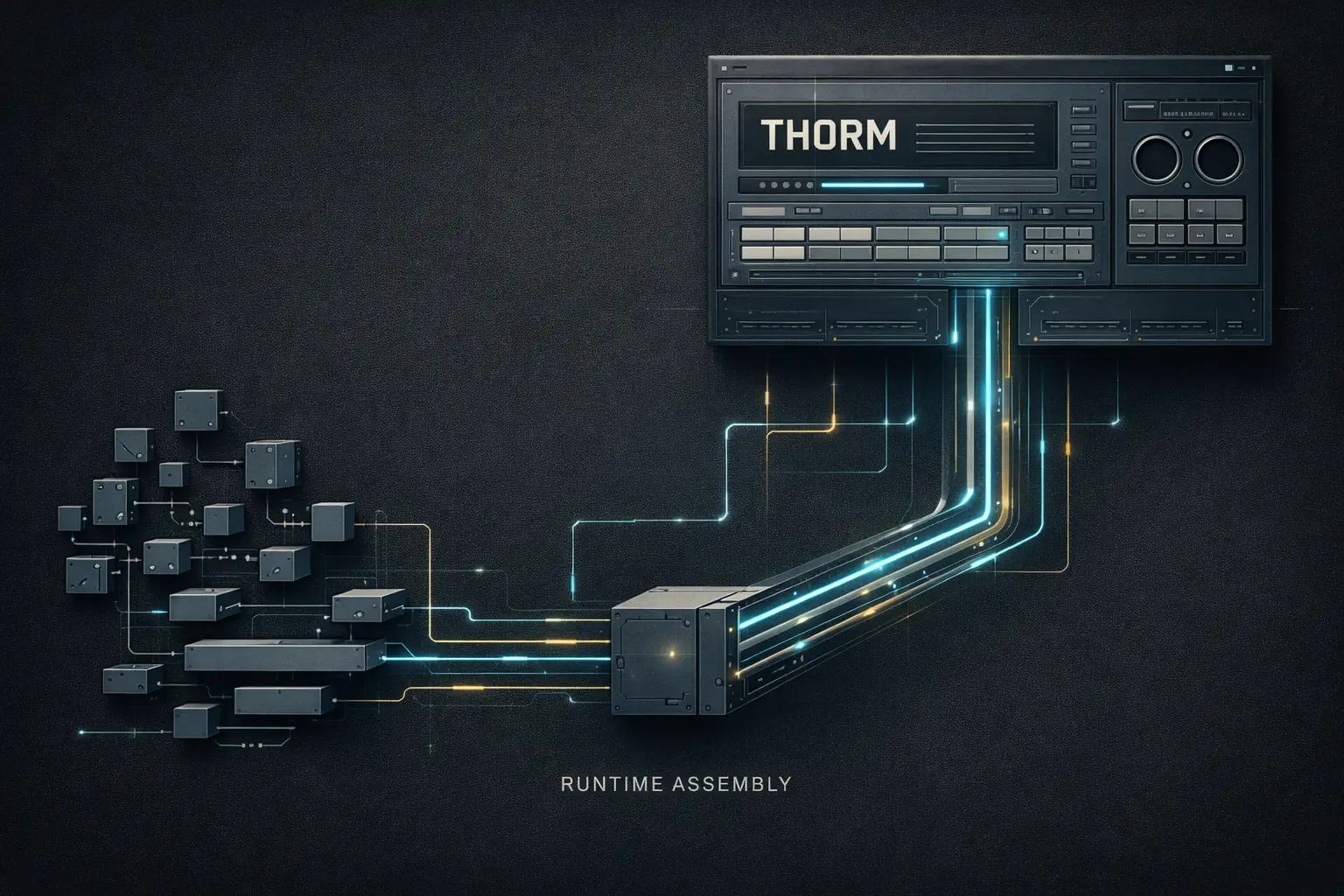
Thorm is a PHP-first UI system that builds a structured UI program and runs it in the browser through a JavaScript runtime.
That distinction matters.
Thorm is not just "PHP that outputs HTML." Underneath the authoring layer, it builds an intermediate representation of the interface: nodes, expressions, state, actions, effects, routing, components, slots. The runtime then evaluates and updates that structure in a controlled way.
In practice, that gives Thorm a few important properties:
- the same mental model can serve SSR, CSR, or hybrid pages
- UI updates are driven by explicit state and expressions
- behavior is described through declarative actions and effects instead of scattered scripts
- interactivity can stay local instead of infecting the whole page
So the short version is this: Thorm is a structured UI runtime with a PHP authoring surface.
Where Thorm gives you leverage
The main advantage is not that Thorm makes impossible things possible. The advantage is that it gives common interactive work a more coherent shape.
A simple example is hybrid rendering. A page can be server-rendered first, then hydrate only the parts that need to come alive in the browser. The model does not need to change just because the delivery mode changes.
Another example is composition. Components, slots, reactive props, effects, routing, and HTTP are not treated as unrelated concerns. They sit inside the same system. That reduces the amount of custom glue code you need to invent for every feature.
That coherence creates practical leverage:
- fewer handoffs between "server code" and "frontend code"
- less ad-hoc JavaScript for common UI behavior
- more predictable rendering and updates
- easier reuse of patterns across pages and features
- a clearer path to SEO-friendly pages with targeted interactivity
Thorm is not magic. It does not remove complexity. It changes where that complexity lives and makes more of it explicit.
Why not just write HTML and JavaScript?
Sometimes you should.
For a tiny page, a small widget, or a one-off interaction, raw HTML and JavaScript are often faster. There is no reason to pretend otherwise. Abstraction only pays for itself when it removes repeated cost.
But that is not the real comparison.
The real comparison is not "Can I hand-write this page today?" The real comparison is "What happens when this page becomes ten pages, then fifty, then a product with shared patterns, interactions, forms, routes, data fetching, and evolving behavior?"
Raw HTML and JavaScript are easy to start with because they ask for almost no structure up front. The bill arrives later. It arrives as duplicated patterns, inconsistent event handling, fragile state wiring, and code that is individually understandable but collectively expensive.
Thorm is a bet that many teams would rather pay for structure earlier and reduce that drift.
Does Thorm still makes sense in the AI world?
AI changes the economics of code generation. It does not remove the need for architecture.
If anything, it makes architecture more important.
When code is cheap to generate, the limiting factor becomes coherence. Can the generated code fit into a system with stable rules? Can it be reviewed without decoding a new style every time? Can it evolve without turning into a landfill of almost-correct patterns?
That is where opinionated systems become more useful, not less.
Thorm gives both humans and AI a narrower surface to work within:
- state is explicit
- rendering primitives are explicit
- actions and effects are explicit
- routing is explicit
- the runtime has a defined model instead of unlimited freedom
That constraint is valuable. A good system is not one that allows everything. A good system is one that makes the useful things easy and the messy things harder.
In an AI-heavy future, the winners may not be the tools that generate the most code. They may be the tools that make generated code easier to trust.
What Thorm is not
Thorm is not trying to replace every frontend framework.
It is not anti-JavaScript. JavaScript is still the runtime. Thorm simply tries to move most day-to-day UI authoring into a more disciplined PHP workflow.
It is not automatically better for every project. If your page is tiny, stable, and mostly static, plain HTML may be enough. If your team is already deeply invested in a mature frontend stack and happy with its tradeoffs, Thorm may not be the right move.
And it is not finished. The project is still in developer preview. That means the design is real, the direction is clear, and the rough edges are still part of the deal.
Who Thorm is for
Thorm is for people who want a more structured way to build interactive web UI without turning every project into a frontend framework migration.
It makes the most sense for:
- PHP developers who want modern reactivity without living in JavaScript framework land
- content-heavy or SEO-sensitive sites that still need interactive areas
- teams that prefer explicit systems over piles of convention and glue
- early adopters willing to trade polish for leverage and direction
The wrong audience is just as important to name. If you want maximum ecosystem maturity today, or if you need a fully battle-tested frontend platform with years of production history behind it, Thorm is not there yet.
The bet behind Thorm
The bet is not that PHP should replace the browser.
The bet is that backend developers deserve a first-class path to modern UI, and that structured systems matter more as interfaces become more dynamic and code becomes easier to generate.
Thorm exists because modern UI work should not require surrendering to chaos just because interactivity showed up.
That is the idea.
Now it has to keep earning the right to be more than an idea.